Forex Broker Hosting for MT4 and MT5
Plan Forex broker hosting for MT4 and MT5: capacity, connectivity, monitoring, backups, recovery and clear operating responsibilities.
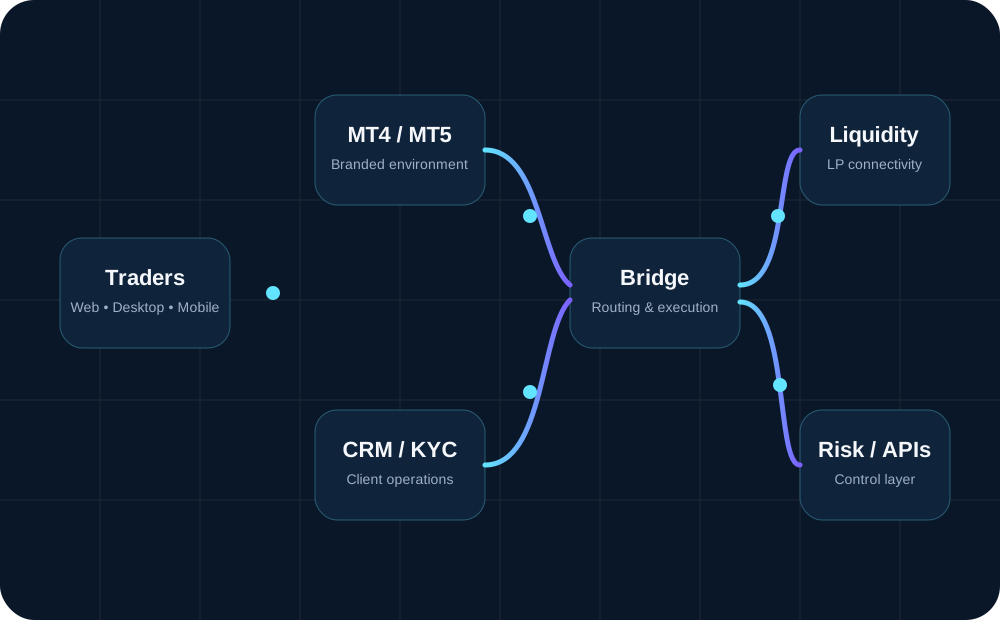
Hosting for the complete broker technology stack
Forex broker hosting needs to support trading services, execution connections, CRM integrations, monitoring and recovery as a connected architecture. Begin by listing the components and their suppliers. Platform permissions, supported deployment options and operating access must be agreed for the selected environment.
Describe simultaneous users, instrument count, quote activity, reporting workload and integration jobs. A server plan should follow these assumptions rather than an arbitrary CPU or memory headline.
Compare deployment responsibilities
| Approach | Who operates it? | Questions to resolve |
|---|---|---|
| Shared service environment | Responsibilities are divided under the service agreement. | What capacity, access, reporting and change controls are included? |
| Dedicated infrastructure | The infrastructure and application operators must be explicitly identified. | Who sizes the workload, patches systems, handles backups and investigates incidents? |
| Client-managed components | Your team operates the contracted layers within the agreed architecture. | Which monitoring, credentials and recovery tasks remain with your team? |
Measure the route that matters
Hosting location alone cannot establish execution latency. Measure connectivity between the actual platform, bridge and liquidity endpoints, plus the client access routes relevant to your audience. Document the measurement method, time window and workload.
Distinguish network round-trip measurements from application response time and order processing. Investigate variability and interruptions, not only the lowest observed value. Review bridge connectivity and liquidity integration together with the hosting design.
Hosting acceptance checklist
| Area | Define | Demonstrate |
|---|---|---|
| Capacity | Expected workload, monitoring thresholds and expansion ownership. | The agreed test workload runs without unresolved resource pressure. |
| Access | Administrator roles, authentication, revocation and change approvals. | The intended roles work and revoked access is blocked. |
| Monitoring | Service health, quote freshness, integration failures and alert routing. | A controlled failure reaches the responsible operator. |
| Backup and restore | Data scope, retention, restore procedure and recovery objectives. | A representative backup can be restored and checked. |
| Incident handling | Severity, escalation, supplier boundaries and communications. | Operators can use the runbook to investigate a defined incident. |
What to include in a hosting request
Send your platform arrangement, component inventory, current workload, target client regions, integration endpoints and required support scope. For a migration, describe the current architecture and cutover constraints. Ask for an itemised proposal covering infrastructure, monitoring, backups, support, additional capacity and termination conditions.
Keep recovery targets and any SLA in the signed scope. They are project requirements to agree and validate, rather than performance figures implied by this page. Use the budget planner to account for recurring infrastructure alongside the platform and integrations.
Broker hosting questions
Is a trader VPS the same as broker hosting?
A trader VPS typically runs a client terminal or trading automation. Broker infrastructure supports the contracted platform services and connected operating systems. Confirm which components and responsibilities your proposal covers.
Does dedicated hosting guarantee faster execution?
No universal guarantee follows from the hosting category. Workload, connectivity, application configuration and execution dependencies all affect observed behaviour. Define and test the relevant measurements.
Can hosting be changed without migrating the whole brokerage?
It depends on the access arrangement and component dependencies. Inventory endpoints, credentials, data, service windows and supplier approvals before planning a change.